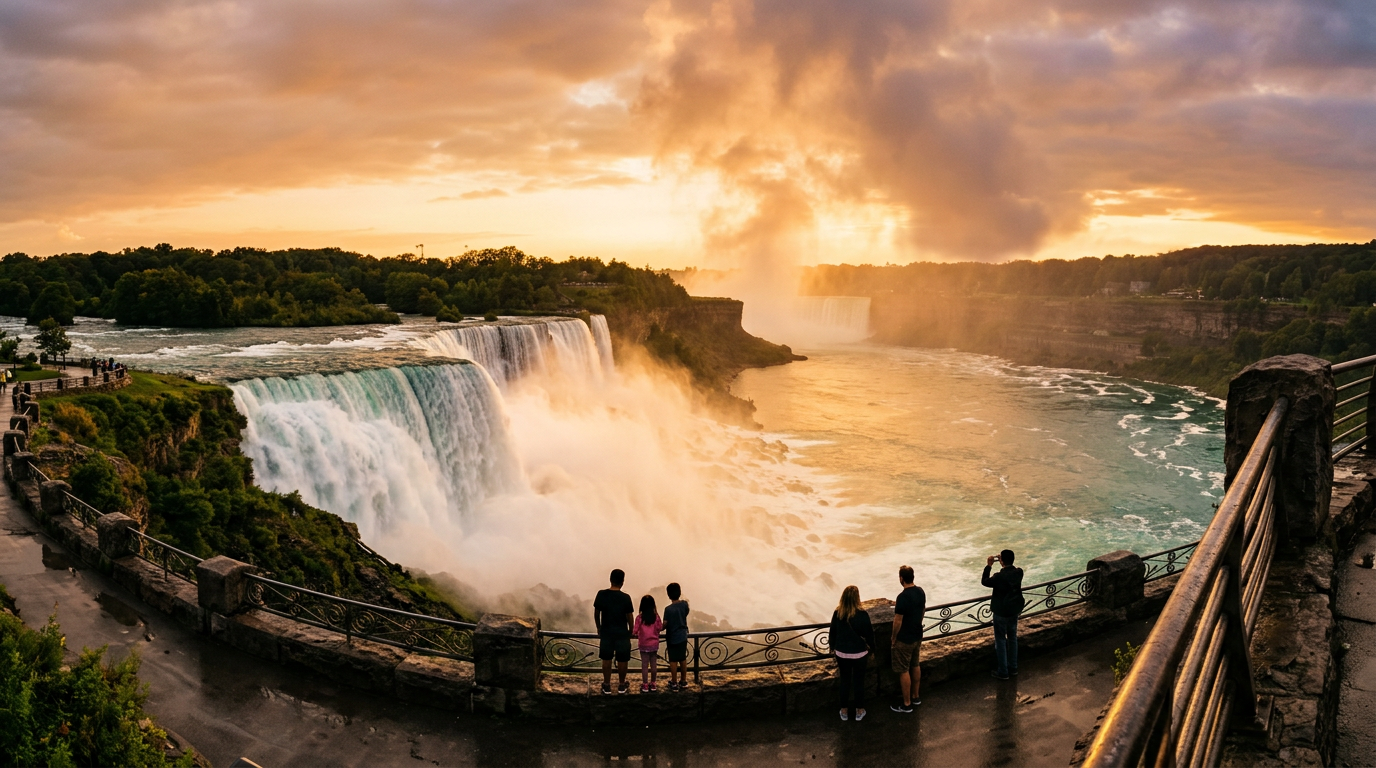
History of Niagara Falls
From glacial geology to 14 million annual visitors — 12,000 years in one place.
In This Guide
How the Falls Were Formed
Niagara Falls is approximately 12,000 years old — young by geological standards. As the last glacial ice sheet retreated northward, it uncovered the Great Lakes basin. Meltwater from Lake Erie found a new path toward Lake Ontario, carving through layers of dolostone and shale over millennia.
The original Falls began at what is now Queenston-Lewiston, about 11km downstream from their current position. The dolostone caprock is harder than the shale beneath it. As water erodes the shale, the caprock eventually collapses — causing the Falls to retreat upstream at a rate of roughly 30cm per year. Left unchecked, Horseshoe Falls would retreat to Lake Erie in about 50,000 years.
The diversion of water for hydroelectric generation (which began in earnest in the 1950s) has slowed erosion significantly. The Niagara Parks Commission and the International Joint Commission now manage water flow to balance tourism, power generation, and erosion control.
Indigenous History
The Neutral Nation (Attawandaron) people lived throughout the Niagara Peninsula for thousands of years before European contact. They called the falls "Onguiaahra" — a word whose exact meaning is debated, but relates to the "strait" or "thundering water." The Neutral Nation was devastated by Haudenosaunee raids in the 1640s and eventually dispersed.
The Haudenosaunee Confederacy (particularly the Seneca) became the dominant Indigenous presence in the region through the 18th century. The 1764 Devil's Hole Massacre near the current location of Whirlpool State Park marked one of the deadliest ambushes in British colonial history — 80 soldiers and teamsters killed along the Niagara portage road.
The Jay Treaty (1794) and the subsequent border settlement established the falls as shared territory between the United States and British-controlled Canada. Both the Seneca and the Mississauga Anishinaabe had treaty rights to the land that were routinely ignored by both governments.
The 19th Century: Tourism Begins
Tourism at Niagara Falls began almost immediately after European settlement. The Hermitage, built in 1827 near the base of the Falls on the Canadian side, is considered North America's first tourist hotel.
By the 1840s, the Niagara Falls area had become the continent's premier honeymoon destination — a reputation cemented when Napoleon Bonaparte's brother Jerome brought his American bride here in 1803. The "honeymoon capital of the world" title stuck for over a century.
The railroad changed everything. When the Great Western Railway reached Niagara Falls in 1853, day-trippers from Toronto and Buffalo could reach the falls in hours rather than days. The population of the tourism district exploded. Thomas Barnett's Museum (opened 1827) became one of the first purpose-built tourist attractions on the Canadian side.
Niagara Falls, Ontario was incorporated as a town in 1904, amalgamating several smaller communities. It became a city in 1966.
The War of 1812
The Niagara Peninsula was the most contested ground of the War of 1812. American forces crossed the Niagara River repeatedly, burning towns and fighting pitched battles from Fort George (Niagara-on-the-Lake) to Lundy's Lane (Niagara Falls).
The Battle of Lundy's Lane (July 25, 1814) remains the bloodiest battle ever fought on Canadian soil — approximately 850 casualties in a single evening, fought in darkness within earshot of the Falls. American forces eventually withdrew after the battle ended in a bloody draw.
The Americans burned Niagara-on-the-Lake (then called Newark) in December 1813 as a deliberate act of reprisal, leaving 400 civilians homeless in winter. The British response was swift — within weeks, they had crossed the Niagara River and burned Lewiston, Youngstown, and ultimately, in August 1814, Washington D.C.
Hydroelectric Power
Niagara Falls was central to the birth of electrical power in North America. The Adams Power Plant, built at Niagara Falls, New York in 1895, was the first large-scale AC power station in the world — designed by Nikola Tesla and backed by George Westinghouse.
On the Canadian side, the Ontario Power Company began generating electricity from the Niagara River in 1905. The Sir Adam Beck Generating Stations (1921 and 1954) on the Niagara River remain two of the largest hydroelectric facilities in Ontario.
The Niagara Parks Power Station (the old Ontario Power Building), which operated from 1905 to 2006, was decommissioned and reopened as a heritage attraction in 2022. The underground tunnels beneath the station, 38 metres below grade, give visitors direct access to the walls of the gorge — an experience unlike anything else in the region.
Frequently Asked Questions
How old is Niagara Falls?
Approximately 12,000 years old, formed as glacial ice retreated after the last ice age.
Why do the Falls move upstream?
The water erodes soft shale beneath the hard dolostone caprock. When the caprock loses support it collapses, retreating the Falls upstream at roughly 30cm per year.
When did tourism start at Niagara Falls?
The first tourist hotel opened in 1827. Tourism exploded after the railway arrived in 1853.